
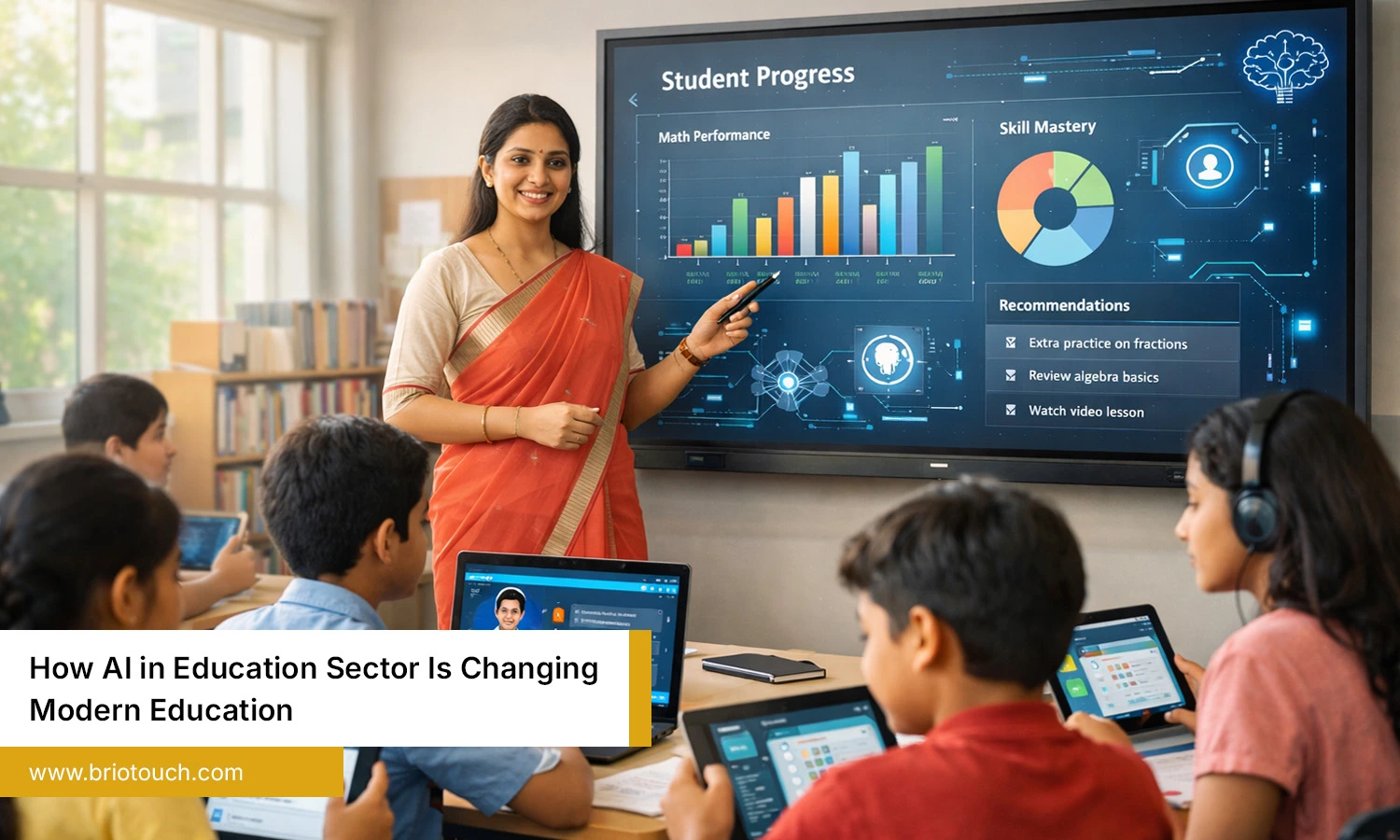
Education is evolving faster than ever, and much of this change is being driven by AI in education sector. What once sounded like a futuristic concept is now influencing how students learn, how teachers teach, and how institutions operate. From personalized learning experiences and intelligent tutoring systems to automated assessments and data-driven insights, Artificial Intelligence is reshaping modern education in practical ways. But alongside the benefits, there are also important questions around challenges, ethics, and the role of educators. In this blog, we’ll explore how AI in education sector is transforming classrooms, improving learning outcomes, and supporting teachers.
Table of Contents
Also Read: Why Schools Should Invest in a Robotics and AI Lab for STEM Education
Why Traditional Education Needs a Change
Traditional education, despite its many strengths, has long struggled with limitations that affect both students and teachers. The one-size-fits-all approach often ignores individual learning speeds, interests, and abilities. In crowded classrooms, providing personalized attention becomes incredibly difficult. Feedback on assignments may take days, sometimes weeks, slowing improvement and motivation. Teachers themselves carry heavy workloads filled with grading, planning, paperwork, and administrative tasks. Over time, engagement can drop as lessons feel either too fast or too slow for different learners. A teacher managing forty to sixty students simply cannot tailor every explanation or activity effectively. As a result, some students fall behind, while others lose interest because they are not challenged enough. These gaps reveal why change became necessary.
Key concerns included:
- Uniform teaching for diverse learners.
- Minimal individual support.
- Delayed feedback and evaluation.
- Administrative overload for teachers.
- Declining student engagement.
This is exactly where AI in education sector begins to create a meaningful shift.
1. Personalized Learning
Personalized learning is one of those changes you can actually feel. In a real classroom, everyone learns differently. Some students get it fast, others need things explained again, maybe in another way. That gap has always existed. AI tools simply respond to it better. They notice when a student keeps making the same mistake, when progress slows down, or when something finally clicks. Then the system adjusts to easier questions, extra practice, and quick explanations. Students don’t feel rushed or left behind. They move forward at a pace that makes sense, which usually builds understanding and confidence over time.
2. Instant Feedback
Feedback has always been a tricky part of learning. Students finish an assignment, submit it, and then wait. Sometimes a few days, sometimes longer. By the time corrections arrive, the topic may not feel as fresh anymore. This is where AI in education sector improve the experience. Instead of delays, responses can appear almost immediately after quizzes, practice questions, or even writing tasks. Students can see what went wrong, fix it, and move on while the lesson still makes sense in their heads. It keeps learning continuously rather than in intervals. And that small moment of seeing correctly instantly gives a surprising boost of motivation.
3. Intelligent Tutoring Systems
Doubts don’t really care about schedules. A student can get stuck on a concept late at night or while revising on a Sunday afternoon, when asking a teacher isn’t always possible. That’s where intelligent tutoring systems start to make sense. AI tutors can step in with quick explanations, simpler breakdowns, or extra practice questions. Sometimes, even a back-and-forth style response feels surprisingly conversational. The biggest advantage is that the availability of help is there whenever it’s needed. No waiting, no feeling awkward about asking again. It’s important to note that this is not intended to substitute for educators. It’s more about giving students support beyond regular classroom hours.
4. Reduced Teacher Workload
Teaching is often seen as just explaining lessons, but the reality is different. A teacher’s day is filled with checking assignments, planning the next class, updating records, and dealing with administrative tasks that never seem to end. It can be exhausting. This is where AI tools begin to feel genuinely helpful. Things like grading objective tests, tracking attendance, or preparing simple performance summaries can happen automatically now. It doesn’t remove the teacher’s role, it simply reduces some of the repetitive load. And when that pressure eases, teachers get more space to do what truly matters: interact with students, offer guidance, and make learning more meaningful.
5. AI-Powered Content Creation
Preparing quality study material has never been a quick task. Teachers often spend long hours putting together questions, notes, worksheets, and revision guides. It’s important work, but also time-heavy. AI tools are beginning to ease this process. They can draft practice questions, create short summaries, suggest exercises, or help structure revision points. The content still needs a teacher’s review, that part doesn’t go away. But starting with something instead of nothing saves time. It allows educators to tweak, adjust, and personalize rather than build everything from scratch. In everyday teaching life, that kind of support can make preparation noticeably smoother.
6. Data-Driven Insights Into Student Performance
Over time, learning platforms collect small bits of information, like which questions students get wrong, where they pause, or how often they revisit a topic. When you look at these pieces together, they start to show patterns. AI simply helps make that picture clearer. It might highlight that a student is slowly losing engagement or that many learners are stuck on the same concept. For teachers, this kind of visibility can be useful. Instead of discovering problems after exams, they can respond earlier. A small adjustment, some extra support sometimes, that’s all it takes to keep learning on track.
7. Improving Accessibility and Inclusion
AI in education sector is also starting to improve how accessible education can be. In traditional setups, students with disabilities or language barriers often needed extra arrangements that were not always easy to provide. AI-powered tools are helping reduce these gaps. Features like speech-to-text, text-to-speech, real-time translation, and adaptive interfaces make learning resources easier to access. A student can listen instead of read, speak instead of type, or view content in a preferred format. These adjustments may seem small, but they can significantly improve participation and confidence. In many ways, this has become one of the most meaningful impacts of AI in education today.
Conclusion
AI in education sector is no longer a distant concept, it is actively shaping how learning is delivered and experienced. From personalized pathways and instant feedback to intelligent tutoring and accessibility tools, AI is helping address gaps that traditional systems struggled to close. It supports teachers by reducing repetitive tasks and gives institutions clearer insight into student progress. Thoughtful implementation, ethical data practices, and teacher involvement remain essential. When used responsibly, AI becomes an enabler rather than a replacement. The real opportunity lies in blending technology with human guidance to create learning environments that are adaptive, inclusive, and genuinely effective.
Discover how Briotouch empowers smart classrooms. Upgrade your teaching experience, enhance student engagement, and bring future-focused learning into your institution today.

