
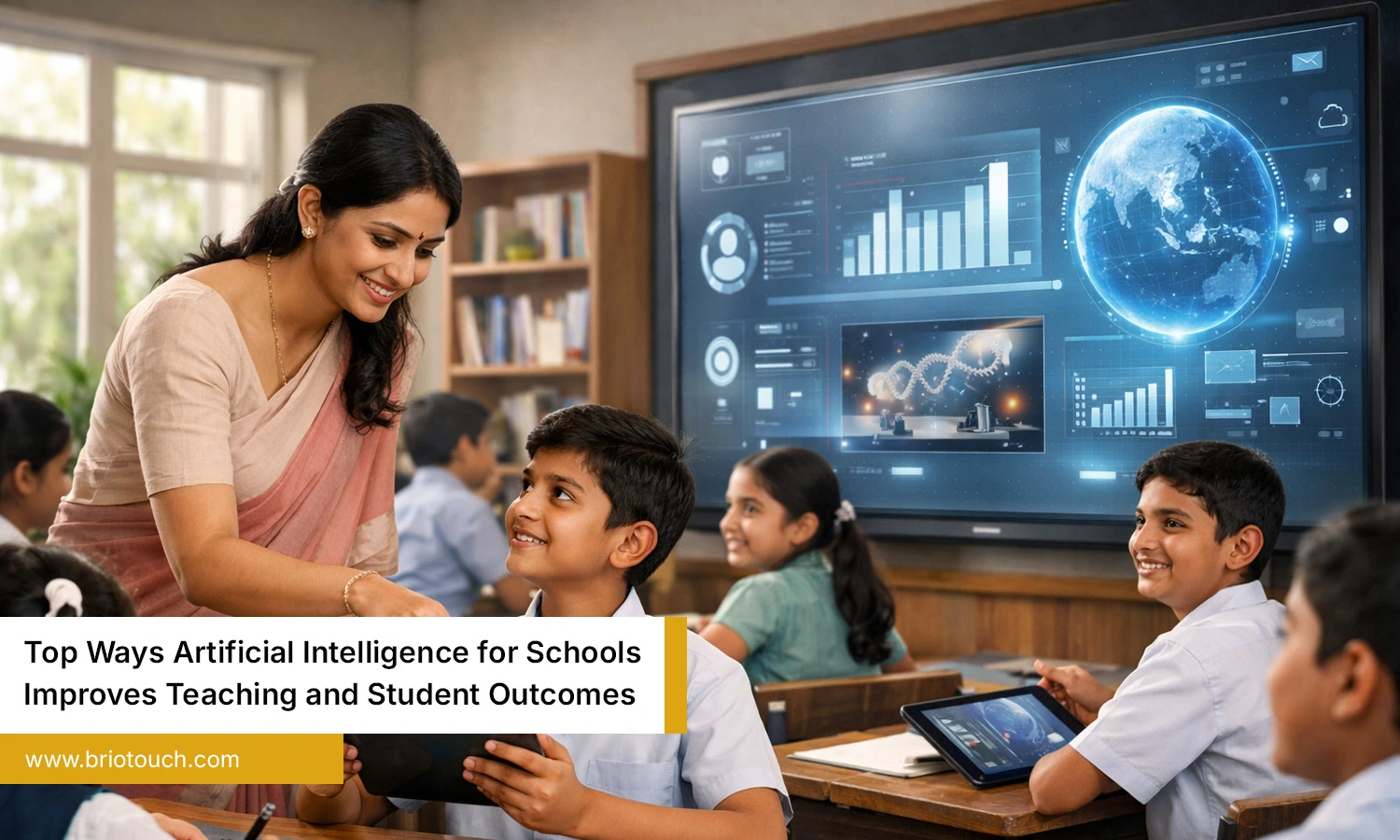
Spend a day inside any school and one thing becomes obvious. Teachers are carrying far more than just lesson plans. Between paperwork, assessments, meetings, and expectations, their workload keeps growing. At the same time, classrooms are filled with students who learn differently and move at different speeds. Most teachers want to give more attention and support, but time and resources are limited. This is where artificial intelligence for schools begins to help in a practical way, not as a replacement for teachers, but as a support system that works quietly alongside them. This blog looks at how AI helps teachers teach better, supports students more effectively, and helps in improving student outcomes.
Table of Contents
Also Read: How Brio AI Is Powering Smarter Learning Through AI in Classroom
How Artificial Intelligence for Schools Supports Teachers
Teaching today is not limited to explaining topics at the front of a classroom. Teachers manage multiple responsibilities every day. Artificial intelligence for schools helps by reducing unnecessary workload, taking care of routine processes, and offering clearer insights. This allows teachers to focus on students rather than on constant administrative pressure.
1. Saving Time on Daily Tasks
One of the most noticeable advantages of artificial intelligence in schools is how much time it saves teachers on a daily basis. Automated systems can check quizzes, assignments, and practice tests quickly and accurately, cutting down hours of manual grading. Attendance records update automatically, and regular reports can be generated without extra effort. By removing repetitive work, teachers spend less time dealing with screens and more time interacting with students. This becomes especially helpful during exam periods, when workload and stress levels are at their highest.
2. Reducing Admin Pressure
Administrative work is a major reason many teachers feel exhausted and disconnected from their role. AI for school helps ease this pressure by handling background tasks that normally take up valuable teaching time. When documentation, tracking, and updates are managed automatically, teachers can return their attention to the classroom. They have more space to explain concepts clearly, respond to questions, and support students who need extra guidance. Many educators feel this shift helps them reconnect with the purpose that brought them into teaching.
3. Understanding Student Progress
AI in schools allows teachers to see student progress as learning happens. AI tools monitor participation, responses, and performance, helping educators quickly identify who is struggling and who is moving ahead confidently. Instead of waiting for exams or reports, teachers can make adjustments during lessons. This early action prevents small misunderstandings from turning into larger learning problems and makes teaching more flexible and responsive.
4. Supporting Lesson Planning
Lesson planning can take hours, especially in classrooms with mixed learning levels. Artificial intelligence software for schools helps simplify this process. AI platforms review curriculum requirements and student data to suggest lesson outlines, activities, and learning materials. Teachers are free to adapt or ignore these suggestions, but they often provide a helpful starting point. This reduces planning stress and saves time each week, allowing educators to focus more on creativity and classroom interaction. Teaching stays personal, while planning becomes easier.
5. Helping New Teachers
For teachers at the beginning of their careers, managing a classroom can feel intimidating. Artificial intelligence tech for schools works like a silent guide, offering insights, lesson ideas, and classroom support without judgment. By showing patterns and highlighting what works, AI reduces uncertainty and builds confidence over time. New teachers feel less alone and more supported as they develop their teaching style. This guidance helps them grow faster and make informed decisions early in their careers.
6. Improving Feedback Quality
AI for schools helps teachers deliver more consistent and meaningful feedback. By tracking student progress over time, AI highlights patterns that may otherwise go unnoticed. Teachers can reflect on what strategies are working and where adjustments are needed. Students benefit from timely feedback, while teachers gain confidence in their instructional choices. Over time, this reflective process improves learning outcomes and strengthens classroom relationships. AI supports teaching without removing the human connection that education depends on.
Improved Student Outcomes
Artificial intelligence in schools is already changing how students experience learning. When lessons match a student’s pace, confusion begins to fade. Students stop guessing and start understanding. AI helps teachers identify learning gaps early, before frustration leads to poor results. Because support comes at the right time, students do not feel labelled or left behind. Engagement improves because learning feels relevant and achievable.
Student outcomes often improve in practical ways:
- Stronger academic performance through personalized learning.
- Greater participation in classrooms.
- Early support for struggling students.
- Increased confidence and reduced exam anxiety.
- Clear progress tracking focused on growth.
When used carefully, AI does not rush students or slow them down unnecessarily. Learning feels balanced and supportive.
Supporting Inclusive and Special Education Needs
Inclusive education requires flexibility. In every classroom, some students need additional time or different support. Teachers understand these needs but cannot always meet them instantly. Artificial intelligence for Education helps bridge this gap quietly. Students who struggle with writing can use speech tools. Learners adjusting to a new language can follow lessons more easily. Small changes remove barriers without drawing attention. Students feel supported, and teachers feel reassured knowing no one is being overlooked.
Conclusion
Artificial intelligence for schools is already present in today’s classrooms, whether schools actively plan for it or not. What truly matters is how this technology is applied. When used thoughtfully, AI reduces pressure instead of creating more work. Teachers gain time, clarity, and breathing space in their daily routines. Students feel supported rather than rushed or overlooked. Learning becomes calmer, more flexible, and easier to manage. AI is not a standalone solution to every challenge. However, when implemented with care, it strengthens education by quietly supporting the people at its center every single day across schools, classrooms, and learning environments.
If your school wants to move forward without losing what truly matters, Briotouch helps you adopt AI for schools in a practical, teacher-friendly way that supports both educators and students.

